You can review a list of our following services below. Click on the service you'd like to learn more information about or scroll down to schedule a free roof inspection:
Asphalt Shingle Roofing
Hail Damage Repair
Roof Leak Repair
Rubber Roof Replacement
Metal Roof Installation
Thomas Roofing and General Contracting, LLC is not a Public Insurance Adjuster and is not providing or offering to provide public adjusting services to its customers. As such, nothing you may read on this website or in any of our other materials should be construed as a promise to negotiate your claim. The information and services provided by Thomas Roofing and General Contracting, LLC are limited to evaluating and discussing damage, repair scope and pricing, and then, once approved, making those repairs to the property.
Most homeowners are not in the business of insurance and may only see a couple of claims in their lifetime.
Just like doctors need medical billing teams, you almost can’t be in business as a contractor anymore unless you know how to navigate insurance claims.
Our team has multiple people who started their careers doing inspections and managing the repair process for insurance carriers.
Our project managers work closely with our insurance estimating team daily to make sure we cooperate with your insurance carrier and work as a team to get your home returned to pre-loss condition.
A competent contractor and a conscientious insurance adjuster are perfectly capable of working these out in most situations.
The Texas Department of Insurance commonly known as the DOI, regulates the insurance industry and they have put out this FAQ to help understand who can do what in this process.
May a roofer or contractor discuss the amount of damage to the consumer’s home, the appropriate replacement, and reasonable cost of replacement with the insurance company?
Yes.
A roofer or contractor may discuss these things with the consumer or insurance company to the extent that they are relevant to the estimate to repair damage to the consumer’s home.
May a roofer or contractor advocate on behalf of a consumer and discuss insurance policy coverages and exclusions?
No.
May a roofer or contractor answer questions about its estimate for a consumer's claim?
Yes.
The roofer or contractor may discuss the scope of work in its repair estimate with the consumer or the consumer’s insurance company.
If an original estimate is later found to be insufficient, may a roofer or contractor answer questions about its revised estimate?
Yes. The roofer or contractor may discuss supplements and clarifications concerning the revised estimate with the consumer or the consumer’s insurance company.
What is an insurance adjuster?
A person who investigates or adjusts losses on behalf of an insurer. An insurance adjuster also supervises the handling of claims. For more information, see Texas Insurance Code Section 4101.001.
What is a public insurance adjuster?
A person who acts on behalf of the homeowner to negotiate the settlement of an insurance claim. For more information, see Texas Insurance Code Section 4102.001. A public insurance adjuster may receive compensation.
Source: Frequently Asked Questions (FAQs) - Unlicensed Individuals, Entities Adjusting Claims
Here are some links from the Texas Department of Insurance and the Texas Attorney General that you may find useful in selecting a reputable contractor or roofer in Texas and navigating the claims process.
How to Avoid Home Improvement Scams
How to Work with Your Homeowners Insurance if You Disagree and What the Texas DOI Can Do to Help
If Your Insurance Company Denies Your Claim, Switching to a New Carrier and Filing Again Later May Not Work Like You Think
Signs of Storm Damage to Your Roof
One of the first things any homeowner should do after a storm is a check for roof damage. Even if you have no visible water inside your home, roof damage is still a possibility.
While it might be tempting to climb up on the roof, we recommend homeowners avoid this whenever possible. Always try to assess roof damage from ground level if you can. Try using a pair of binoculars to see more clearly before making the decision to use a ladder.
On its own, rain is not usually enough to damage a structurally sound roof. Add wind, flying debris, and hail to the mix, however, and roofs may take a serious pounding.
Sometimes, roof damage is obvious to the eye. Still, you should take your time and look closely when assessing your situation. Some symptoms can be surprisingly hard to spot.
Let’s review some of the most common types of storm damage:
Signs of Wind Damage
Damaging winds are classified as those exceeding 50 miles per hour. Winds associated with severe thunderstorms or hurricanes are often called “straight-line” winds to differentiate them from tornadoes. Wind damage is associated with more than half of all severe weather events.
Signs of wind damage include:
1. Missing Shingles
Shingles that were already cracked or peeling are at major risk of being lost once wind speeds exceed 60 miles per hour. Although roofing manufacturers cover severe winds in their warranty, the estimated wind speed a roof can endure is based on a new, well-maintained roof.
2. Visible Granule Loss
Some granule loss is common, especially with a brand new roof. With storm damage, granule loss is found in characteristic horizontal lines. This indicates where the shingle seal was broken. Granules rub off as shingles flap in the wind and come into contact with other surfaces.
3. Visible Water Infiltration
Most visible leaks that penetrate through to the ceiling of the building are the direct result of wind damage. In these cases, both the shingles and the roof underlayment are compromised, allowing water to flood into the attic or the upper rooms of the building.
4. Loose Debris
Any loose debris you notice around your home – such as yard waste, outdoor furniture, and so on – could indicate something struck your roof during high winds. Clear debris away as soon as you can to minimize risk and look for characteristic broken shingle patterns to assess impacts.
Signs of Hail and Snow Damage
Hail forms in strong thunderstorm clouds at temperatures of 32°F and below, the same range at which snow is possible. Hailstones are balls of ice, usually most damaging between 1 inch and 1.75 inches in diameter. Because they are compact, they can punch through solid objects.
Signs of hail damage include:
1. Missing or Hail-Damaged Shingles
Hail damage can result in immediate loss of shingles that were intact before the storm started. Even if shingles are still present, they may be in need of replacement. Look for cracks and dents with a characteristic round shape showing the location of impact.
2. Clogged or Broken Gutters and Downspouts
After a storm, clogged gutters should be cleaned out as soon as possible. Water drains from a broken gutter directly down into the foot of the building. In time, this can erode the foundation and make the structure unsafe. Check all gutters and downspouts for bending and dislocation.
3. Ice Dams
Shingle roofs that have not been maintained correctly are prone to ice dams. Ice dams develop as a result of snowmelt freezing on the eaves of the roof. This ridge of ice prevents additional water from melting snow from leaving the roof and can encourage leaks. Most ice dams are easily visible.
Signs of Water Damage
It’s not just water driven by high wind that damages a structure. Even a small amount of standing moisture from a storm can lead to serious issues. With that in mind, it’s important to examine your home and surroundings carefully even after winds die down.
Signs of water damage include:
1. Damage to Roof Supports or Accents
It might not always be obvious if supporting elements of your roof are damaged. Even if shingles appear to be completely intact, look for areas where water seems to pool during or after heavy rain. Also check flashing around vent pipes, your chimney, and other elements.
2. Visible Attic Issues and Moisture
Your roof and attic make up a whole ecosystem that works together closely. Check your attic for any signs of moisture penetration that can disclose leaks. Inundated surfaces and insulation may need to be replaced to stop the development of dangerous mold or mildew.
Storm damage remediation is an essential part of protecting your home and peace of mind. To get started, just contact our expert team today.
To find out more or schedule a roof inspection, Contact Us today.
Waking up in the morning after a strong storm and finding hail damage to your car isn’t a great way to start the day. Depending on the hail’s size, it can cause significant damage not only to your car but the rest of your property as well.
One crucial piece of your property that you need to think about when it hails is your roof. Hail will shorten your roof’s lifespan and can even lead to a full roof replacement.
But hail damage can be tricky to spot on a roof if you don’t know where to look. That’s why we’re going to break down what hail damage looks like on your roof.
We have provided help and guidance for homeowners in McKinney going through the insurance process for over 20 years. After your claim is approved, we work tirelessly to ensure your insurance company gives you everything your roof needs. That’s why we like to say, “We work for you, not the insurance company.”
By the end of this article, you’ll learn what hail damage looks like on a roof, how to spot it from the ground, and 3 things to know before starting the insurance process.
What does hail damage look like on a roof?
Hail damage to your roof is either really noticeable or hard to spot. If the hail is large enough (1” in diameter or bigger), you’ll see dents/dings on your shingles.
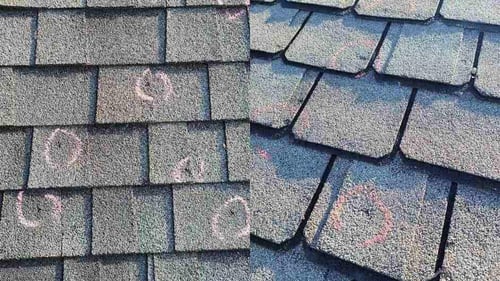
But just because your roof doesn’t have large dents in the shingles doesn’t mean you won’t have hail damage. More signs of hail damage to your roof are dings/dents/splatter marks to your roof vents, gutters, roof flashing, and other roof penetrations.
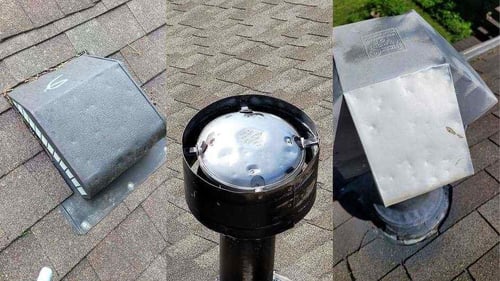
If your roof has any of the damage listed above, it’s a good chance you’ll have a homeowners insurance claim. Your first instinct might be to call a roofing contractor as soon as you suspect roof damage.
But the first thing you should do if you think you have hail damage is call your insurance company. While a local roofing contractor can advise you about the process, they can't do any actual work (repairs or a replacement) until your insurance adjuster approves the hail damage claim.
How to tell if you have hail damage from the safety of the ground
I don’t recommend for anyone who doesn’t know how to walk on a roof safely to check for the damage mentioned above. There’s no reason to put yourself in danger when your insurance company sends someone out to check it.
But I understand wanting to do your due diligence before filing an insurance claim. Below is a list of things to check for visible hail damage from the safety of the ground:
- Downspouts (Above 5 feet, so it can’t be blamed on a lawnmower)
- Dings or strikes to your garage door
- Holes in your window screens
- Dings to any painted wood or shutters
- Splatter marks or dings to your electric meter, AC unit, or grill
- Dents to your mailbox and other soft metals on your property
- Dents on the top of your car and the car’s hood
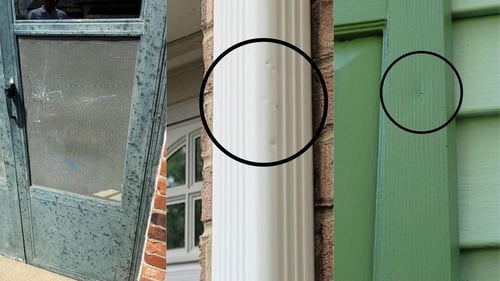
This list doesn’t mean your roof has extensive hail damage. It just gives you an idea if you should contact your insurance company and file a claim.
3 things to know before starting the insurance claim process
Now that you know how to spot hail damage, there are some things you need to know before filing a claim. Below are 3 things to know before starting the insurance claim process.
1. The insurance process is muddy and confusing
Both the roofing industry and the insurance industry don’t have the best reputation. The unfortunate truth is that there are a lot of roofing and insurance companies who don't necessarily have your best interest in mind.
That’s why we like to say the insurance process can be muddy and confusing. Some companies use this to their advantage and scam homeowners who are desperate to get their roof problem taken care of.
That’s not to say that all roofing or insurance companies are out to take advantage of you. All we're trying to do is let you know that there are people on both sides who unfortunately try to take advantage of people in a stressful situation.
Understanding this from the beginning helps you be aware to ensure something like this doesn’t happen to you.
2. Don’t sign any paperwork until your roof insurance claim is approved
Honestly speaking, the roofing industry doesn’t have the best reputation. One of the reasons it gained this reputation is because some roofing companies try to strong-arm homeowners into signing something before they’ll inspect the roof.
Even if you're panicking when you have storm damage, don’t sign any paperwork from a roofing company before your insurance claim is actually approved.
If they want you to sign something, they're trying to lock you into a contract that gives them the right to your roof before your claim has even been approved. When this happens, you won’t get to choose your own roofing contractor.
On the other hand, a reputable roofing contractor walks you through the insurance process and gives you an honest assessment of if your roof has storm damage or not. Then if your insurance claim is approved, they’ll ask for your business.
3. Insurance adjusters sometimes make mistakes
Everyone is human and makes mistakes, even insurance adjusters. Most of the time, an insurance adjuster will spot storm damage, but sometimes they make a mistake and deny your claim.
If they deny your claim, there’s no reason to panic. There are ways to double and triple-check your roof for storm damage.
The best way to get a second opinion is to ask for a second insurance adjuster to come out and inspect your roof. If they approve your claim, great, but sometimes the second adjuster will still insist that the roof is not viable for a claim.
If you still think you have storm damage after the second adjuster says no, you can have an engineer come out to your home, inspect the roof, and then offer proof (if they have any) to your insurance company that that roof needs to be replaced because of storm damage.
Ready to learn the homeowners insurance process?
You just learned 3 things to know before starting the insurance claim process. If you think you have hail damage, you’re ready to call your insurance company and start the claim process.
But before reaching out to the insurance company, you need to ask yourself, “Do I know what to expect from the process?” If you don’t, you’re not alone.
The insurance claim process can be stressful and full of headaches, especially if you haven’t been through it before. To help you prepare for dealing with your insurance company, we broke down the homeowners insurance claim process.
The team at TX Roofing & GC has helped homeowners in McKinney and surrounding areas with their insurance claims before. If a big storm hits your roof, we’ll work with you and your insurance company to ensure you have a positive experience. If you’re local to McKinney and the Dallas - Forth Worth Metro and have hail or other storm damage, contact us to help you during this stressful time.
We all depend on quality roofing, but how much time do we spend thinking about our roofs?
We only seem to think about roofing when something goes wrong, like when we find a leak.
Finding a leak in your roof can cause alarm, but sometimes it can be a simple fix, as long as you act quickly.
A leaky roof is something that doesn't improve over time. It gets substantially worse every day it goes untreated.
It's always in your best interest to have roof leaks repaired right away, so they don't turn into the monumental job of roof replacement.
If you have multiple leaks along with other signs of roof damage, it could mean it's time for a new roof.
Replacing a damaged roof will prevent more leaks from springing up and prevent water damage from occurring in your home.
Sometimes you may be tempted to try and replace your roof yourself.
In the article below, we will discuss what a roof leak means, and whether you will need to repair or replace your roof.
How To Find Roof Leaks
Step one in deciding whether you need to repair or replace your roof is finding the leaks.
And finding it isn't always as easy as it sounds.
A leak in your roof tends to be higher than the obvious spot you can see on the inside.
Water gets in under the shingles and travels down the rafters before finally dripping down onto your ceiling.
Once it starts dripping, it can begin to pool, causing sagging or bubbling, but it could keep traveling until it finds a light fixture or another opening to seep through.
Here are a few tips for finding pesky leaks in your roof:
- Get into your attic and locate where the water is leaking through the ceiling. Move aside any exposed fiberglass insulation. You should wear long sleeves, goggles, and a dust mask to protect yourself from the insulation.
- Now start looking for water damage. Check above the ceiling leak and look around the sheathing that leads to the peak of the roof. This might not be a direct line, but it will always be above the location of the ceiling leak.
- Get a friend to climb onto the exterior of your roof and start running water. This could take a few minutes until you can notice water coming through.
- Once you find where the water is coming through, mark the location. Then have your friend measure from the ridgeline of the roof down the same distance. Now you know where your roof is leaking.
Common Causes of Roof Leaks
The first step in repairing roof leaks or replacing a roof is knowing what caused the leak in the first place.
Weather like high winds and hail can easily damage your asphalt shingles.
Falling branches during a storm can also cause leaks in your roof. The older your shingles are, the more prone they are to leaks after large storms.
But bear in mind that misdiagnosing a leak can lead to further damage.
If you aren't 100% sure of what is causing the leaks, get the help of a professional roofing contractor.
Depending on what caused the damage, your insurance company may cover the replacement of your roof, but they will require a licensed professional to do the work.
A missing shingle creates an easy opening for water to get through.
Many shingles come with wind ratings, and they typically exceed local weather requirements, but it is still possible for the wind to rip shingles off of your home.
Even a cracked or damaged shingle creates an easy opening for water to get into your home.
To reduce the chances of your shingles being damaged, keep all nearby trees trimmed and get shingles with a high hail rating.
As your roof ages, wood can swell and settle, causing gaps to form around flashing, creating an entry point for water.
Your flashing itself can also fail, and when it does, you need to replace it immediately.
Signs You Need Immediate Roof Repair or Replacement
Below are a few signs you need to immediately repair a leak in your roof or have your roof replaced.
Missing or Damaged Shingles
The shingles on the roof of your home are the front line defense against water leaks.
If you're missing a shingle, have damaged or cracked shingles, whether they were blown away by the wind or damaged by falling tree branches, they can easily be replaced.
And they should be replaced as soon as possible.
Any part of your roof left exposed to the elements due to missing shingles can allow water to seep in through nail holes. The nail holes should be sealed.
One tiny leak isn't much to worry about, but if you have multiple significant leaks in your roof, it may be time to start considering a complete roof replacement.
Leaks in Flashing
Tile roofs are especially prone to leaks in the flashing or underlayment in your roof.
A tile roof is designed to last a very long time, but flashing and seams need constant maintenance and upkeep to repair and prevent leaks.
Sagging Areas
If you notice that your roof is sagging, you need to stop questioning whether it can be fixed and call a professional roofing contractor.
They will need to inspect your roof to determine whether you have a problem with your roof's decking.
The foundation of homes has also been known to cause roof sagging.
The only way to know what's causing your roof to sag for sure is to hire a professional to inspect it.
Damage to the decking of your roof could require an entire tear down and a replacement of your entire roof to protect your home from further damage.
A Damp Attic
A damp attic in your home is usually caused by one of two things.
It may be a result of your attic not being ventilated properly, or it could mean that you have a leaky roof.
Maybe you notice the dampness only after heavy rainstorms, or maybe it is fairly consistent.
Either way, you need to use the tips above to inspect the roof yourself, or you might need to call in a professional to do it for you.
You should never turn a blind eye to a damp attic because you could end up paying for expensive repairs or needing a new roof altogether if you do.
Contact TX Roofing and GC If Your Roof Is Leaking
No matter how minor you think a roof in your leak may be, it is always better to be safe than sorry and call a professional.
A seemingly minor leak, especially if left untreated, can worsen as time passes, ultimately leading to damage to your home and a complete roof replacement.
And if your roof isn't obviously leaking, roof inspections should still happen every three years just to make sure everything is in order.
Once you start to notice multiple leaks or other signs of roof damage, it may be time to replace your entire roof.
To make sure your roof is healthy and your leaks are harmless and can be easily repaired, contact TX Roofing and GC, so a roofing contractor can find your leaks and suggest repairs.
And if your roof needs to be replaced, they can go over the costs involved and find the right plan for your new roof.
To schedule your Free Inspection and Estimate with one of our certified roofing contractors, click on the button below.
If you’re preparing for a new construction project or need to replace a damaged roof, do you know which material is best for your needs? There are three types of rubber roofing (EPDM, TPO, and PVC), which are long-lasting options that offers many benefits you may not have considered.
RUBBER VS. TRADITIONAL ROOFING
Rubber roofing is made of rubber or plastic polymers or a combination of both. Materials are eco-friendly, made from recycled tires, sawdust, and slate dust. Rubber roofing is used to reduce leaking and to produce more impenetrable sealing. Single-ply synthetic membrane roofing is strong, waterproof, and pliant. Rubber roofing can go where typical asphalt roofing cannot due to its flexible nature.
Rubber shingles can be more expensive than asphalt shingles, but they are cheaper than slate shingles and equivalently fire resistant. The total price may vary depending on the specific material you choose as well as roofing contractors’ labor costs in your area, but rubber shingles typically cost about $4.25-$8.25 per square foot—equaling approximately $425-$825 per square when installed—while asphalt shingles are around $100-$150 per square; however, rubber can last twice as long and save you a lot of money in energy efficiency over the years.
LIFESPAN
Your rubber roof will last you a very long time, and you’ll be surprised at how little maintenance and upkeep are needed. Most houses have asphalt shingles that typically last 15-20 years and require quite a bit of attention throughout that time. Rubber roofing, on the other hand, can last 30-50 years, requiring little maintenance. If installed correctly, you might never experience any cracking or leaking at all. If you do find that you have a crack or leak, you can most likely fix it simply by covering it with a latex sealant.
WEATHER-RESISTANCE
Rubber shingles or rolls are much stronger and less likely to crack during extreme weather conditions than asphalt roofing. They are especially beneficial for flat or low-pitch roofs that traditional shingles have trouble effectively protecting due to the lack of gravitational pull. When roofs are flatter, water damage is common, as water does not run off as quickly as on steeper roofs, allowing it to be blown underneath shingles that are not well sealed.
In addition to being weather resistant and completely waterproof, rubber roofing is also very resistant to thermal shock. If installed properly, rubber roofing shouldn’t crack or become brittle due to hot or cold temperatures. It’s able to withstand hail and other extreme weather conditions and shows very high resistance to ultraviolet radiation and cyclic fatigue.
RUBBER ROOF INSTALLATION
Rubber roofing installation is a much easier and quicker process than asphalt or slate roofing installation. A seamless roll is generally the most cost effective and energy efficient form of rubber roofing. It is very unlikely to leak or crack because there are no seams for water to flow underneath. Shingles need to be nailed down like traditional shingles would, and they cost more than rolls. Rubber shingles, however, are much lighter than slate or asphalt shingles, which makes them easier to move and place.
To apply the roofing, first strip down your current roofing to the plywood base. If you’re using a roll, measure and trim it to the shape of your roof, cutting space out for chimneys, vents, etc. Then sweep off your roof to get rid of dirt and debris, apply adhesive, and place the roll appropriately across your roof. Be sure to check for air bubbles underneath. If you’re applying shingles, nail down in rows as you would asphalt shingles.
Sometimes rubber roofing is placed on top of old shingles with a layer of foam insulation in between. The rubber roofing then serves as a waterproof membrane. Doing it this way can save time, labor costs, and also reflect heat from the sun away from the roof, keeping your home cooler. Keep in mind, however, that if you don’t first strip your roof down to the base, manufacturers usually will not recognize your warranty.
Do you have an asphalt shingle roof? Here’s what you need to know about it.
Learn all about asphalt shingles, the most popular choice of roofing material for decades in America.
What Are Asphalt Shingles Made From?
Asphalt shingles are not made of asphalt all the way through. Rather, they consist of either a fiberglass or felt paper base coated with a waterproof later of asphalt and topped with ceramic granules. Since its development in the 1980s, the fiberglass base has been the more popular product. It is lighter and less expensive but still lends considerable strength to the roof, as well as additional fire protection.
What Types of Shingles Are Available?
Shingles are manufactured as either three-tab shingles or architectural shingles. The three-tab variety is designed to look like three shingles though it is actually all one piece. It is easy to install, economical, and very popular. Architectural shingles are manufactured with an additional layer of asphalt to give them more dimension and enable them to mimic the look of bulkier roofing products like wood or slate. Both types of shingles come in a large variety of colors to suit just about any home design.
Are Asphalt Shingles Eco-Friendly?
Although the old-fashioned felt paper-backed shingles do contain recycled paper, their higher asphalt content makes them less eco-friendly. However, many companies are now offering fiberglass shingles that incorporate features such as solar reflective asphalt that can help prevent the sun’s rays from heating up a building. This offers an eco-friendly benefit in terms of saving energy that would otherwise be needed for cooling the building.
How Long Do Asphalt Shingles Last?
A variety of factors can affect shingle life, including weather, roof pitch, quality of installation, and of course the quality of the shingle. Shop around and you will find warranties ranging from 15 to 30 years. Depending on the quality of your choice of shingles, you can expect your shingles to reach the upper end of whatever lifespan the manufacturer promises for them.
How Do I Know When My Shingles Need to be Replaced?
If you notice any of the following issues, you should consult an experienced roofer about replacing your asphalt shingles:
- Curled or buckled shingles
- Missing shingles
- Cracked shingles
- Lifted shingles
- Ceramic granules accumulate in your gutters and downspouts
How Much is a New Asphalt Shingle Roof Going to Cost Me?
Asphalt shingle roofs are very economical for two reasons. First of all, the shingles themselves are affordable. Secondly, asphalt shingles are very easy to install, which keeps your labor costs low. So long as your roof deck is in good condition and you currently only have one layer of shingles on it, your new shingles can be applied directly over your old ones for an even faster and more economical job.